Bellows & Barley — a medieval city building sim in your browser
A settlement that lives on chains
You begin with a hamlet: a few cottages, one woodcutter, two gardens. You end — if you get that far — with a free city of 105 workshops. The real work lies in between: finding out what it is that is holding everything up.
Because nothing comes from nowhere. Planks need timber, tools need iron and charcoal, bread needs grain, flour and a baker who is not currently helping out at the carpenter’s. Every good hangs on a chain of things made before it, and every chain hangs on people who are then missing somewhere else. All 105 goods and their chains are laid out before you start.
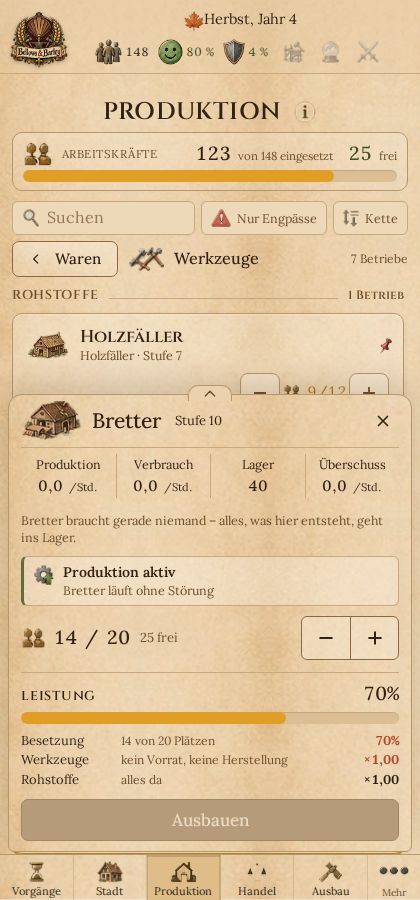
The clock keeps running while you are away
A game year takes a real day — or six hours, or three; you decide when you found the world. What you order in the evening is done by morning. The game does not want hours at a stretch, it wants short visits: see what has happened, decide what runs next, close it again.
What will keep you busy
Assigning workers when 337 people sit idle and the clothing runs out at the same time. Finding the tax rate where the treasury holds and the mood does too. Deciding whether the planks go into the warehouse or into the next cottage. And eventually noticing that the quarry has been running at a third for twelve years because the tools never suffice. A look inside shows what that looks like.
No account, no cost, no install
It runs in your browser, on desktop and on your phone. No ads, no purchases, no analytics. An account is optional and does one thing: it makes your saved games follow you from one device to the next — without one they stay in this browser. Questions and answers covers the rest.